Custom App Development: Costs, Timelines, and How to Choose a Vendor
A guide for business owners and executives: when a custom app makes sense, what drives its cost and timeline, published price ranges in Mexico, key changes in 2025 and 2026, and a checklist for choosing a vendor.

Custom app development makes sense when your operation has outgrown Excel, WhatsApp chats, and software licenses that don't talk to each other. Its cost depends more on scope and integrations than on the number of screens. In Mexico, published ranges go from under $100,000 MXN for a narrowly scoped system to more than $2 million MXN for an enterprise platform. That's why choosing a vendor matters as much as the idea itself: it determines who owns the code, how your data is protected, and how much you'll pay to maintain the app.
If you're not technical, keep one idea in mind: a custom app is an investment with ongoing costs, not a one-time purchase, and you should plan for it that way from day one.
What custom app development is and how it differs
A custom app is designed and built around your process: your rules, your roles, and your systems. Off-the-shelf software solves the average process of many companies. A template or no-code tool lets you put something together quickly, but only within its limits.
| Criteria | Custom | Off-the-shelf software | Template or no-code |
|---|---|---|---|
| Fit with your process | Complete | You adapt to it | Partial |
| Upfront investment | High | Low | Low |
| Recurring cost | Maintenance and cloud | Licenses | Subscription |
| Integrations | Whatever you need | Whatever the vendor offers | Available connectors |
| Code ownership | Yours, if the contract says so | The vendor's | The platform's |
| Time to launch | Weeks or months | Days | Days or weeks |
Rule of thumb: if off-the-shelf software covers your process without forcing you to change how you operate, start there. Custom applications make sense when that process is your competitive advantage or when licenses and workarounds already cost more than solving it properly.
Signs your business needs one and which type to choose
- Processes running on Excel and WhatsApp: orders or approvals are entered multiple times, and no one knows which version is correct.
- Disconnected systems: your CRM, ERP, and invoicing don't share data, and someone reconciles them by hand.
- Paying for features you don't use: you pay for full plans just to use a single module.
- Customers asking for self-service: they want to check status, download invoices, or book appointments without calling you.
Types of business apps by industry
| Type | What it's for | Industry example |
|---|---|---|
| Mobile app | Field work and frequent use | Logistics: proof of delivery |
| Web app | Access from any browser | Services: scheduling and quotes |
| Internal system | Operations and control | Retail: multi-location inventory |
| Customer portal | Self-service | Finance: account statements and requests |
A real-world logistics example is the parcel delivery management app we built for Vajesed (Tu Envío).
Custom application development, step by step
Here's what happens from idea to launch, and what your business is responsible for at each stage:
- Define the problem and the metric. On one page, describe the process, who uses it, and how you'll measure success (data entry time, errors, or orders per day). Name an internal owner who can make decisions.
- Run a discovery phase with the vendor. Review the processes, systems, and personal data involved to agree on the scope of the first version and confirm integrations. Include the people who actually run the process, not just managers.
- Validate a prototype. Test clickable screens with real users before any coding, while changes are still cheap, and approve it in writing.
- Review short deliveries. The vendor should show you demos every one or two weeks; you review and prioritize them, which keeps progress and budget under control.
- Test and launch. Run a pilot with a small group, fix issues, and publish using app store and cloud accounts in your company's name. Train your team and publish your privacy notice.
- Measure and improve. Compare the metric from step 1 against real operations and decide the next phase based on usage data, not opinions.
Where AI fits in and which features to request from the start
AI is already part of developers' daily work: it speeds up coding, testing, documentation, and prototyping. But developers themselves have limited trust in what it produces, so the code still needs human review and testing. Ask your vendor how they use it and who validates the output.
AI features worth planning for from the design stage:
- An AI agent on WhatsApp to check order status or book appointments. Meta charges for the WhatsApp Business API per message, and rates vary by country (Meta's official pricing), so it's a recurring operating expense.
- Document reading for invoices or purchase orders, to avoid manual data entry.
- Natural language search across manuals and internal policies.
Even if AI comes in a second phase, have the data and connections (APIs) it will need ready from the start.
How much custom software costs and what drives the price
Factors that drive cost and timeline
- Scope: number of processes, roles, and business rules.
- Integrations: according to a Mexican agency that publishes its price ranges, connecting an ERP, CRM, or payment system moves the price more than the number of screens.
- Platforms: according to another agency, building for web and mobile costs 1.5 to 1.8 times as much as a single platform.
- Maintenance: agencies estimate it at 10% to 25% of the initial cost per year.
Published ranges (there are no official prices)
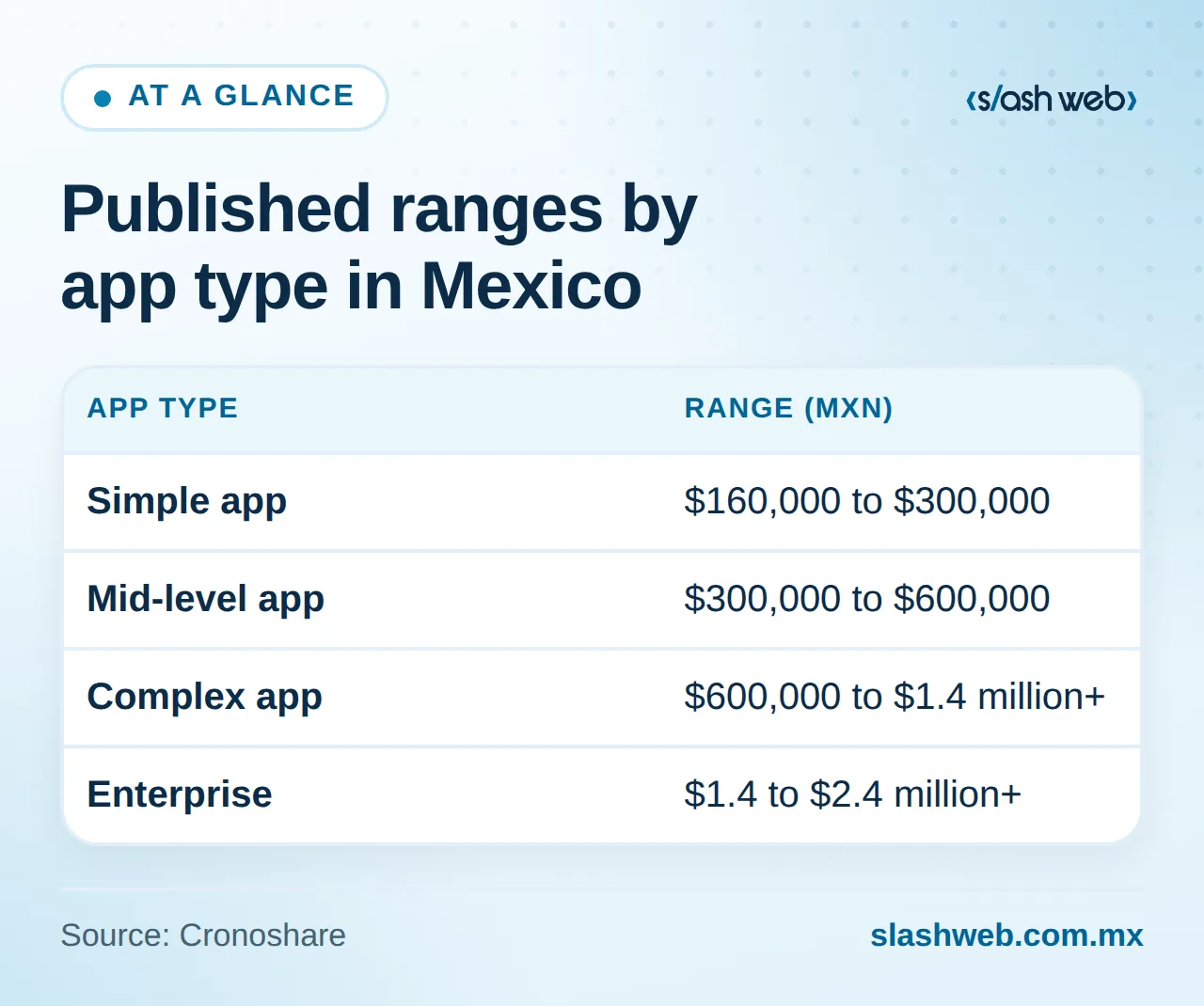
There are no official prices; there are only ranges from agencies and marketplaces that vary quite a bit. The marketplace Cronoshare (August 2026) reports:
- Simple app: $160,000 to $300,000 MXN (200 to 300 hours).
- Mid-level app: $300,000 to $600,000 MXN.
- Complex app: $600,000 to $1.4 million MXN or more.
- Enterprise: $1.4 to $2.4 million MXN or more.
The same source notes that an Apple Developer account costs $1,780 MXN per year and a Google Play account costs $460 MXN as a one-time fee. Mexican agencies, for their part, publish rates of $400 to $1,600 MXN per hour and narrowly scoped systems from $80,000 to $250,000 MXN. On timelines, they cite 6 to 10 weeks for an MVP and 6 to 12 months for a multi-module ERP.
Illustrative example
A mid-sized parcel delivery company wants an app for its drivers and a web dashboard for its operations. Suppose the app alone is quoted at $350,000 MXN. With the 1.5 to 1.8 multiplier, adding the dashboard would bring the project to between $525,000 and $630,000 MXN. If the company sets aside 15% per year for maintenance, it should budget $78,750 to $94,500 MXN annually, plus cloud and WhatsApp messaging costs. These figures are illustrative, meant to help size the project, not a quote.
What changed in 2025 and 2026
- Personal data: Mexico's new Federal Law on the Protection of Personal Data Held by Private Parties (LFPDPPP) was published in the Official Gazette (DOF) on March 20, 2025, and took effect the following day. INAI's functions were transferred to the Ministry of Anti-Corruption and Good Governance. Using data for a new purpose requires obtaining consent again, and the confidentiality obligation extends to your vendors. In addition, Article 29 requires designating a person or department to handle ARCO rights (access, rectification, cancellation, and opposition). Your app should log consents and make those requests easy to handle.
- Android: Google requires developers to verify their identity, even for apps distributed outside the Play Store. The first phase began on September 30, 2026, in Brazil, Indonesia, Singapore, and Thailand; the global rollout is planned for 2027.
How to choose a vendor: checklist and common mistakes
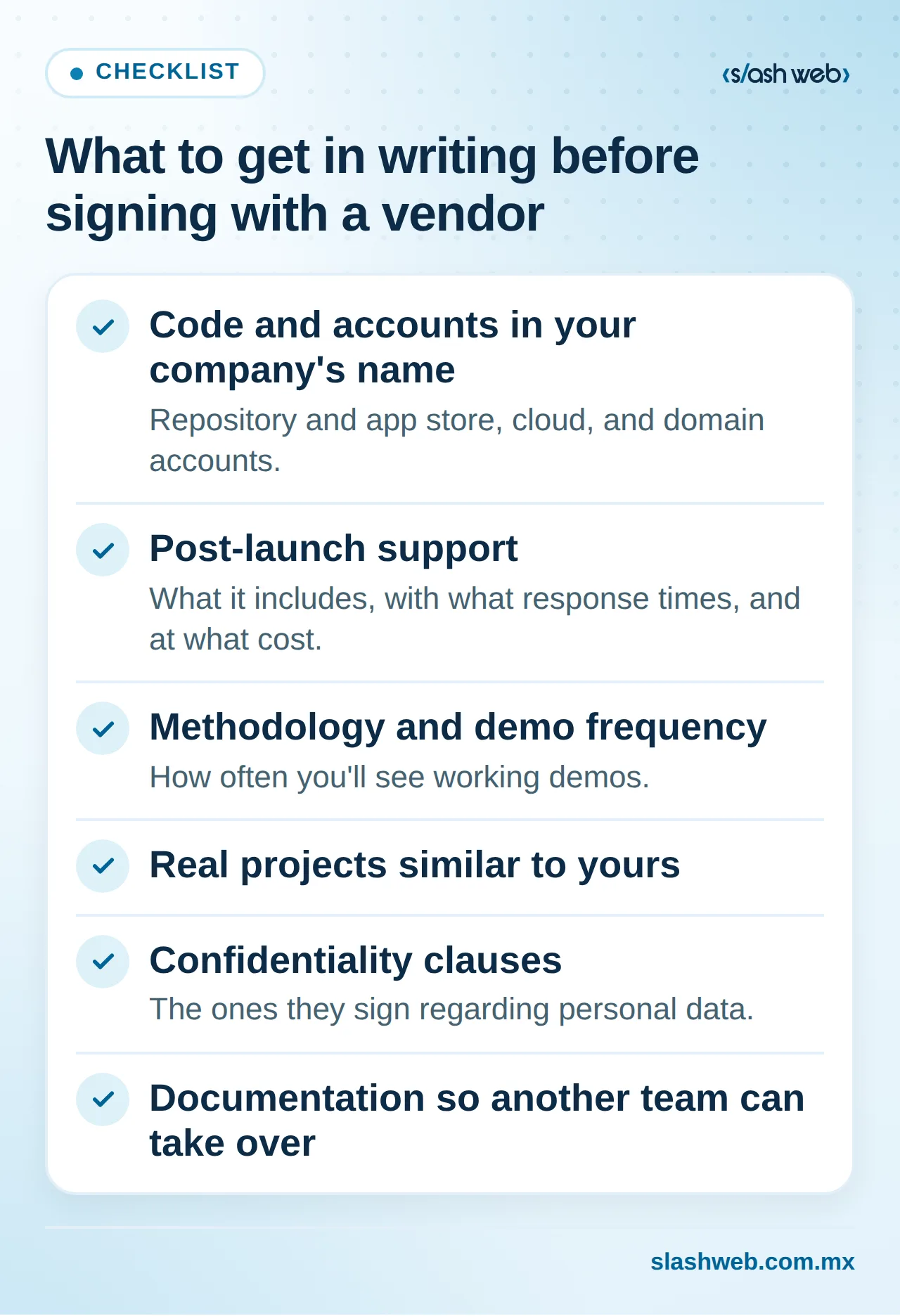
Before signing, get these answers in writing:
- Will the code, the repository, and the app store, cloud, and domain accounts be in my company's name?
- What does post-launch support include, with what response times, and at what cost?
- What methodology do you use, and how often will I see working demos?
- Can you show me real projects similar to mine?
- What confidentiality clauses do you sign regarding personal data?
- How do you use AI when coding, and who reviews what it generates?
- Do you deliver documentation so another team could take over?
The type of vendor also affects the price. One Mexican agency reports that, for an equivalent first phase, a freelancer charges $40,000 to $90,000 MXN, while a large consulting firm charges $250,000 to $600,000 MXN or more.
Common mistakes and how to avoid them
- Comparing quotes by number of screens: ask each proposal to detail integrations and assumptions.
- Forgetting about maintenance: include it in the budget from the start.
- Leaving accounts in the vendor's name: open them yourself and grant the vendor access.
- Wanting everything in the first version: launch the most critical process and grow in phases.
- Thinking about privacy at the end: design the privacy notice, consents, and ARCO workflow alongside the screens.
What to do this week
- Map one process: write down every step that runs through Excel or WhatsApp and how many times the same data gets entered.
- Take inventory of your licenses: list how much you pay for each piece of software and which features your team actually uses.
- Review your accounts: confirm that your domain, cloud, and developer accounts are in your company's name. If you have an Android app, get ready for identity verification.
Conclusion
Custom app development is worth it when it solves a process that sets you apart or that currently costs you time, errors, and licenses. Start with a measurable problem and budget for integrations and maintenance. Protect personal data from the design stage, and choose a vendor that leaves you as the owner of the code.
At Slashweb, we've been delivering mobile and web app development for businesses and custom software integrated with your systems since 2016. Tell us about your project on WhatsApp or through our contact form, and we'll help you define the scope of your first version.
Frequently asked questions
Should I build a native or cross-platform app?
For most business apps, a cross-platform technology like Flutter or React Native lets you maintain a single codebase for iOS and Android, which usually reduces time and cost. Going native is justified when the app relies heavily on the phone's hardware or needs maximum performance. Decide with your vendor based on the features in the first version.
Do I need an in-house technical team to have a custom app?
No. What's essential is someone on the business side who knows the process, makes decisions, and reviews progress. The vendor can handle hosting, support, and updates, as long as they give you access so you don't depend on them.
What if my current system doesn't have an API?
There are still options: connecting to the database with read-only permissions, exchanging files on a schedule, or using automations that operate the system's interface. Each alternative has a different cost and risk, so it's evaluated during discovery. If the system is very old, it sometimes makes sense to replace only the critical module.
Can I switch vendors mid-project?
Yes, if the repository and accounts have been in your name from the start. Even so, the new team will need time to review the code before moving forward, so it's a good idea to request a brief technical audit. Switching vendors without that access usually means redoing parts of the work.
Slashweb
Want to apply this in your company?
Book a free call with a specialist and get a tailored proposal.