
AI Agents That Buy: Block Them, Allow Them, or Integrate?
United blocked third-party AI agents, OpenAI launched ChatGPT Wallet, and Brave charges them per query. What changes when an agent is the buyer, and how to decide whether to block, allow with limits, or integrate.

AI agents that buy are no longer an experiment. Between November 11 and 13, United Airlines banned third-party agents from booking on behalf of its customers, OpenAI launched ChatGPT Wallet with Visa, Mastercard, and American Express, and Brave started charging agents for every query. If you sell online, especially to US customers, you need to choose: block them, allow them with limits, or integrate with them.
If you don't choose, your fraud prevention system and your login will choose for you. They may reject legitimate sales because an agent browses like a bot, or let through purchases and account changes the customer never authorized. This applies to travel and hospitality, e-commerce, healthcare, professional services, and exporters.
For now, OpenAI's wallet only works for Pro subscribers in the United States. That window is the time you have to measure how much agent traffic you receive and set rules before the volume grows.
What happened in three days: United, ChatGPT Wallet, and Brave
- United shuts the door (November 11). The airline will not allow third-party personal AI agents, whether on its website and app or through travel agencies and aggregators. According to TechCrunch, it gave three reasons: sharing passwords with an assistant exposes sensitive data, agents can make unwanted purchases or account changes or spend miles, and federal aviation rules. Agents can still display flights and fares, but a person has to complete the purchase, and United may cancel bookings made by an agent without notice.
- Brave charges them per use (November 12). Its search API accepts payments through the x402 protocol: the agent pays for each query on the spot, in USDC on the Base network, with no account or API key, at $0.005 per query, according to Brave's official announcement.
- OpenAI gives them a wallet (November 13). ChatGPT Wallet lets its agents, called "dots," complete purchases. It was developed with American Express, Mastercard, and Visa, and the payment travels as tokens: neither the agent nor the merchant sees the card details, according to CNBC.
A week earlier, Bank of America had already asked its customers not to share passwords with AI assistants. The Hacker News thread about United passed 700 comments: the debate is no longer whether agents will buy, but under what conditions.
What changes when the buyer is an agent
In agentic commerce, a person gives an instruction ("book me a hotel in Mérida for the long weekend, within this budget") and the agent searches, compares, and pays. That breaks three assumptions almost every checkout is built on.
Identity: you no longer know who's on the other side
Your site assumes that whoever logs in is the account holder. If the customer handed their password to an agent, the agent and an attacker look the same to your system.
Consent: what exactly did the customer authorize?
"Find options" is not the same as "pay for whatever you find." If you have no evidence of the scope of the permission, every disputed charge becomes your word against the customer's.
Fraud prevention: normal now looks suspicious
An agent typically browses fast, from cloud servers, and without human behavior: the same pattern as a fraudulent bot. Rules designed for people reject legitimate sales; loose rules open the door to account takeover. Tokenized payments, like those in ChatGPT Wallet, solve card exposure, but not identity or consent: those still depend on your rules.
Block, allow with limits, or integrate: the three stances
| Stance | Risks | Technical requirements | Real-world example |
|---|---|---|---|
| Block | Lost sales and not showing up in assistants | Agent detection, firewall rules, clear terms | United: the agent browses, the person buys |
| Allow with limits | Unauthorized purchases and chargebacks | Tokenized payment, spending caps, account holder confirmation | ChatGPT Wallet: token-based payment at the merchant's checkout |
| Integrate | Upfront investment and prices exposed in real time | API or MCP server, per-agent credentials, automated billing | Brave: charges for each query with x402 |
It's not all or nothing: United combines stances, letting agents browse while blocking purchases. As a rule of thumb:
- Blocking makes sense if your transactions are irreversible, you handle balances or points with real value, or you're in a sector with sensitive data, such as healthcare.
- Allowing with limits fits most online stores, hotels, and service businesses: you accept the agent, but a person confirms the big decisions.
- Integrating pays off if your availability changes quickly (rates, inventory, appointments) or if you sell digital services on a usage basis. There, stablecoin micropayments, like Brave does with x402, are an option you can implement with blockchain development for payments.
Illustrative example: a boutique hotel in Quintana Roo
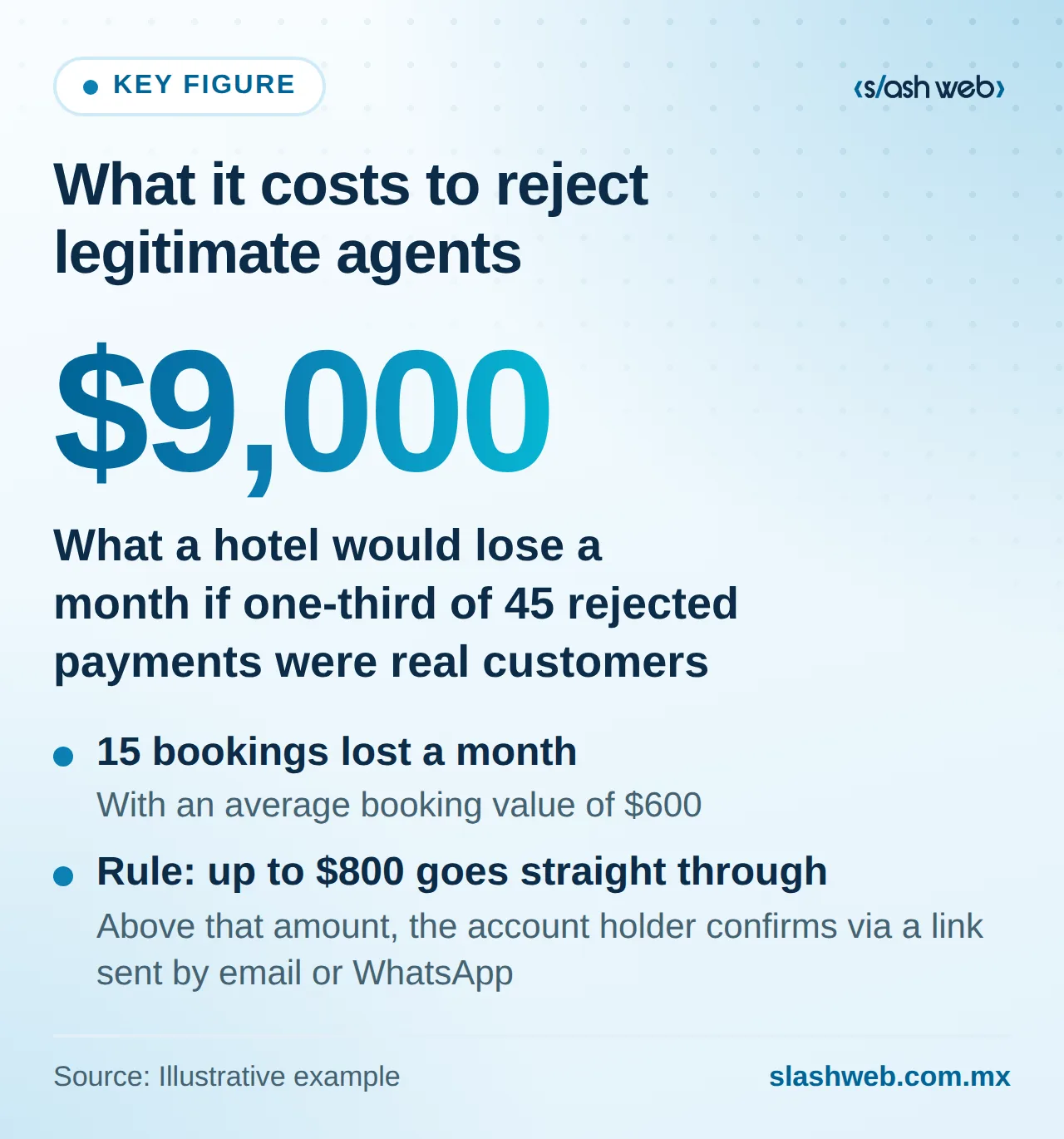
The figures are hypothetical. A hotel gets 3,000 booking sessions a month, a large share from US customers. Reviewing its logs, it finds 150 sessions with an agent pattern, and its fraud system rejected 45 payment attempts. With an average booking value of $600, if just one-third of those rejections were real customers, it lost 15 bookings: $9,000 a month.
Instead of blocking everything or opening the floodgates, the hotel sets rules: agents can request quotes; bookings up to $800 with tokenized payment go straight through; above that amount, or for non-refundable rates, the account holder confirms via a link sent by email or WhatsApp. It recovers sales without giving the agent control over anything irreversible.
Step-by-step guide to handling AI agents that buy
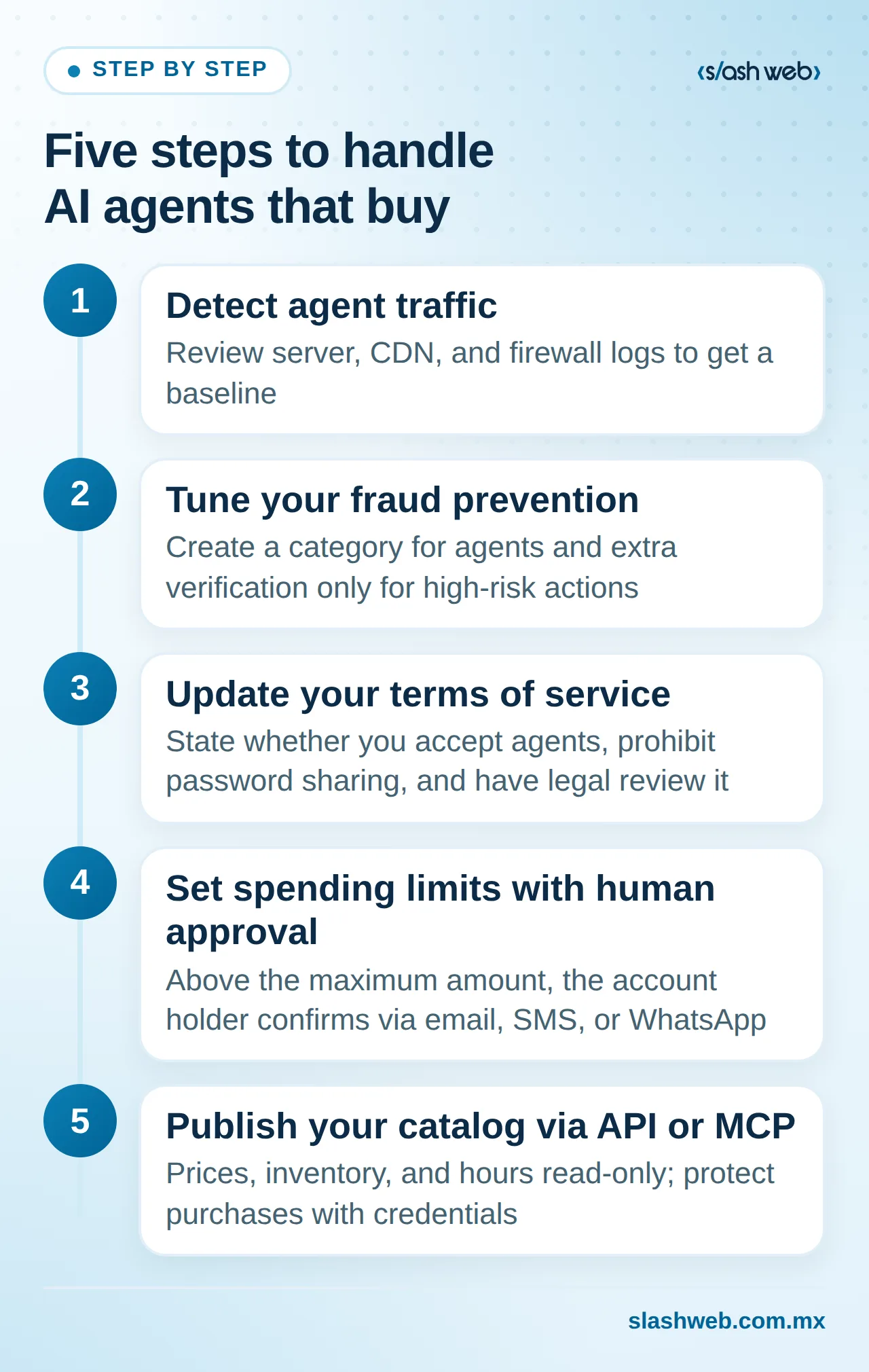
- Detect agent traffic. Work with your technical team to review server, CDN, and web application firewall logs: user agents that identify as assistants, traffic from cloud IP ranges, and sessions that reach checkout in seconds. Outcome: a baseline of visits, carts, and purchases made by agents.
- Tune your fraud prevention. Create a category for agents instead of treating them like any other bot, and require extra verification (a code sent to the account holder or 3-D Secure) only for high-risk actions, such as email changes, points redemptions, or cancellations. Outcome: fewer legitimate sales rejected without making account takeover easier.
- Update your terms of service. State whether you accept agents, prohibit password sharing, and define who is responsible for a mistaken purchase and how it gets canceled. Have your legal team review it. Outcome: clear rules for resolving disputes.
- Set spending limits with human approval. Establish a maximum amount per transaction and per day for agent purchases; above the limit, the account holder confirms via email, SMS, or WhatsApp. Outcome: the agent speeds things up and the person makes the important calls.
- Publish your catalog and availability via API or MCP. Expose prices, inventory, hours, and policies through a structured, read-only service, and protect purchase operations with credentials. MCP (Model Context Protocol) is an open standard that lets AI models query data and use external tools. If your platform doesn't support it, a custom software layer can connect to your ERP or booking system. Outcome: agents read accurate data instead of scraping your site.
Checklist at a glance
- You know how much of your traffic and purchases comes from agents
- Your fraud prevention distinguishes agents from malicious bots
- Your terms mention agents and prohibit password sharing
- There's a maximum amount for purchases without human confirmation
- Redemptions and account changes are always confirmed by the account holder
- Your catalog and availability are in a documented API
Common mistakes with AI agent payments
- Blocking everything by default. A generic anti-bot rule can stop legitimate agents and also crawlers you actually want. Better: measure first and block by action, not by visitor.
- Tolerating shared passwords. If the agent logs in with the customer's session, you don't know who's acting. Better: offer an official channel (API or tokenized payment) and ask your customers not to share credentials.
- Not keeping evidence. Without a record of what was requested, at what price, and who confirmed it, every chargeback costs more. Better: log the source, amount, confirmation, and timestamp of every agent transaction.
- Exposing too much data. A rushed API can leak internal pricing or customer data. Better: read-only access to the public catalog and per-agent rate limits.
What to do this week
- Ask your technical team or vendor for a report covering the last 30 days, with traffic that looks like it comes from agents and the payments your fraud system rejected.
- List the five riskiest actions on your site or app (redemptions, email changes, cancellations, large purchases) and decide which ones will require account holder confirmation.
- Draft a paragraph about AI agents for your terms of service and share it with your legal team.
Conclusion
AI agents that buy now have a wallet, a payment protocol, and, in United's case, a closed door. There's no single right stance for everyone: it depends on how reversible your transactions are, how sensitive your data is, and how much you sell to US customers. What you don't want is to let your fraud system decide on its own.
At Slashweb, we build AI agents and integrations connected to CRM, ERP, and payment systems for companies in Mexico and the United States. If you want to review your checkout and define your stance on agentic commerce, tell us about your project.
Frequently asked questions
Can AI agents that buy already make purchases at Mexican stores?
ChatGPT Wallet is currently only available to Pro subscribers in the United States, but an agent can browse any site using the credentials its user provides. That's why the first wave will likely come from US customers booking or buying from Mexican businesses. Preparing now lets you test rules while volume is still low.
Does blocking AI agents affect my Google rankings?
Blocking shopping agents is not the same as blocking search engine crawlers, but a misconfigured rule can stop both. Make sure your firewall rules distinguish by visitor type and by action. After any change, check Google Search Console to confirm your site is still being crawled normally.
Do I need to accept cryptocurrency to charge an agent?
No. Tokenized card payments, like the ChatGPT Wallet model, run on the networks you already accept. Protocols like x402 with stablecoins make more sense when you charge very small usage-based amounts, where card fees can outweigh the charge itself.
How should I handle AI agents in sectors with sensitive data, such as healthcare?
The prudent approach is to let the agent only check availability, hours, or prices, and to require the patient for scheduling, payment, or access to clinical information. That way you benefit from the agent's convenience without exposing protected data. Document this policy in your privacy notice and terms so patients know what they can delegate.
Slashweb
Want to apply this in your company?
Book a free call with a specialist and get a tailored proposal.