RAG for Business: Build an Assistant With Your Internal Knowledge
An internal AI assistant can search manuals, policies, and procedures to provide answers with sources. Learn how to implement RAG, protect information, and measure its usefulness before scaling.

Your company probably already has answers to many operational questions, but they are scattered across manuals, shared folders, and PDF files. RAG for business connects that knowledge to an AI assistant that finds relevant information and responds with references, rather than relying solely on the model’s general knowledge.
The challenge is not enabling a chat interface that accepts documents. It is ensuring that everyone can access current, authorized information that is useful for their work. This guide explains how to build an internal AI assistant, what controls it needs, and how to assess whether it actually reduces time spent searching and handling repetitive questions.
1. What RAG for business is and when to use it
RAG stands for Retrieval-Augmented Generation. It combines a search mechanism that retrieves information from authorized sources with a language model that drafts an answer using the retrieved passages.
For example, someone asks: “What authorization do I need to accept a return after the deadline?” The system finds the applicable procedure and gives the model the relevant sections. The assistant explains the requirements and shows the document, section, and version.
RAG is not the same as retraining a model on all your files. Knowledge is retrieved during the interaction. This makes it easier to incorporate document changes without retraining the model, as long as synchronization is implemented correctly.
It is useful when recurring questions have documented answers. On its own, it does not resolve conflicting policies, incomplete files, or decisions that require professional judgment. It also does not eliminate incorrect answers: it needs evaluation and mechanisms to recognize when evidence is missing.
2. Use cases: start with a narrowly defined need
An initial project should serve one team, one set of documents, and one specific task. “Answer any question about the company” makes it difficult to assign ownership and verify results.
| Department or industry | Useful question | Required sources |
|---|---|---|
| Logistics | How to handle a rejected delivery | Procedures and service agreements |
| Construction | What to check before accepting materials | Specifications and checklists |
| Professional services | How to prepare a deliverable | Approved methodologies and templates |
| Human resources | What the requirements are for a vacation request | Current policies by entity or location |
| Internal support | How to resolve a known issue | Manuals and validated technical articles |
In healthcare or fintech, it is best to start with low-risk administrative questions. Clinical, credit, or regulatory recommendations require additional controls and specialized review.
Also distinguish between retrieving knowledge and taking action. Explaining an expense policy is a document-based task; approving a reimbursement requires authorization and transactional integration. AI agents and business chatbots can combine capabilities, but each action needs its own rules.
3. Prepare your documents before connecting AI
The assistant’s quality depends on what it can retrieve. If two manuals say different things, a well-written answer may hide the problem rather than solve it.
Before indexing, prepare an inventory with these fields:
- Owner: who validates the content and authorizes changes.
- Currency: review date, version, and superseded documents.
- Scope: the company, branch, product, or process it applies to.
- Confidentiality: the people and groups allowed to access it.
- Original location: a stable link for verifying the answer.
Remove duplicates and separate drafts from approved documents. Scanned PDFs may need optical character recognition; tables require extraction that preserves headers and relationships between columns.
Next, divide the content into meaningful chunks. Cutting a policy in half can separate a rule from its exceptions. Preserve titles, numbering, and metadata so the system can retrieve enough context.
Also define how updates are published and how information is removed. Replacing a file is not enough if its previous version remains available in the search index.
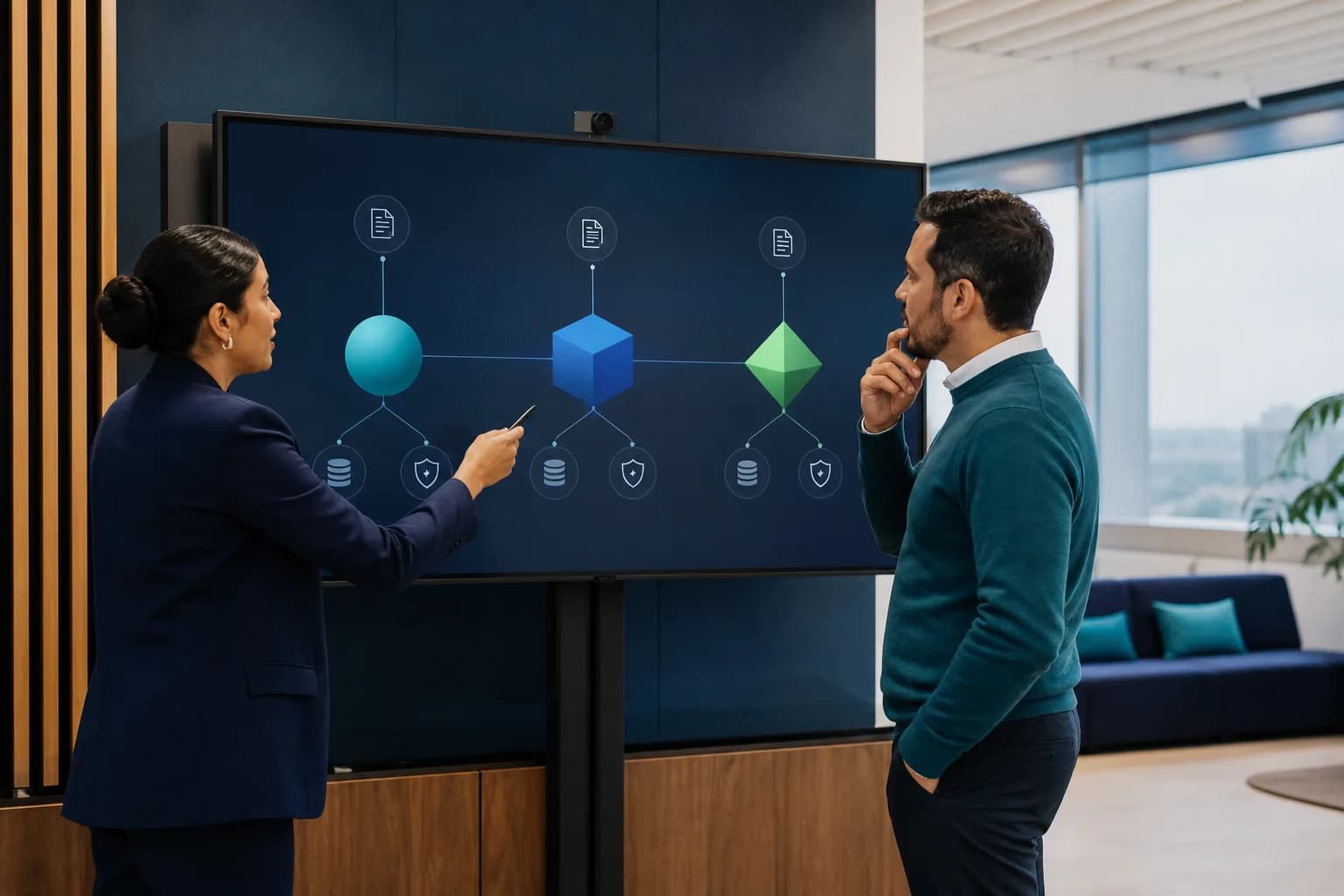
4. How an internal assistant’s architecture works
A typical implementation has two workflows: preparing knowledge and answering questions.
Preparing knowledge
Connectors read approved sources, extract text and metadata, and generate an index. This may include numerical representations called embeddings, which make it possible to find passages based on similarity in meaning.
Hybrid search combines that similarity with keyword matching. It is useful when queries contain product codes, contract names, or identifiers that need exact matching rather than approximate interpretation.
Answering a question
The workflow should include these steps:
- Authenticate the user and identify their permissions.
- Search for applicable passages within authorized content.
- Rank the results and select relevant evidence.
- Ask the model to generate an answer based on that evidence.
- Show references and log what is needed to evaluate the service.
If information is missing, the assistant should ask for clarification or state that it did not find sufficient supporting evidence. Each reference should make it possible to verify the corresponding claim; adding links at the end does not, by itself, prove that an answer is correct.
To check current balances, inventory, or statuses, it is usually better to access an API from the source system. An indexed document may be outdated. That is why an AI integration must distinguish between document-based knowledge and real-time operational data.
5. Security: permissions before model instructions
Telling the assistant “do not disclose confidential information” is not a substitute for access control. Unauthorized content must stay out of the context the model receives, with permission checks on every query.
Minimum controls include:
- Identity- and role-based access: respect restrictions by department, client, or project.
- Effective access revocation: update permissions and clear caches when access changes.
- Data protection: encryption, secure credential handling, and minimization of personal information.
- Traceability: log sources used and incidents without storing unnecessary sensitive data.
- Provider terms: review retention, processing locations, and data use for training.
Prompt injection is another risk: a document could contain text that attempts to alter the assistant’s behavior. Retrieved files must be treated as evidence, not instructions, and must not be able to enable tools or modify permissions.
If you operate in Mexico, review the personal data protection obligations that apply to your organization. Involve legal and security teams before connecting records, financial information, or employment data.
6. Design a pilot you can evaluate
Before development, gather real questions from the team and expected answers validated by process owners. Include ambiguous queries, conflicting documents, questions with no answer, and requests for restricted information.
Evaluate two aspects separately: whether the search system retrieves the right evidence and whether the model interprets it correctly. An incorrect answer can originate at either stage.
Measure at least:
- Accuracy and supporting evidence: correct answers supported by current sources.
- Appropriate abstention: recognition of insufficient evidence.
- Permission compliance: no data leaks in access tests.
- Resolution time: comparison with manual searches for the same type of question.
- Operating cost: model usage, search, storage, and document maintenance.
Define acceptance criteria before testing. Do not expand the scope if leaks or critical errors appear. Assign owners to correct documents and repeat evaluations after changing connectors, models, or configurations.
7. Conclusion: turn scattered knowledge into verifiable answers
RAG for business can make internal knowledge easier to access when it combines reliable sources, relevant retrieval, permissions, and ongoing evaluation. The best starting point is not uploading every file, but addressing a frequent need within a controlled scope.
At Slashweb, we can help you evaluate your use case and design its integration with your systems. Contact us to discuss your AI project: share what questions your team needs to answer, where the information lives, and who should have access to it.
Frequently asked questions
Do RAG and fine-tuning serve the same purpose?
No. RAG retrieves information from external sources during a query, while fine-tuning adjusts a model’s behavior through examples. They can complement each other, but fine-tuning a model does not replace an up-to-date, verifiable repository.
Can a RAG assistant work in Spanish and English?
Yes, if the selected retrieval and generation models support both languages. You should test queries in one language against documents written in the other, especially when technical terms or internal abbreviations are involved.
Can an internal AI assistant be deployed on your own infrastructure?
Yes, architectures can run on your own infrastructure, in a private cloud, or in hybrid environments. The choice depends on confidentiality requirements, computing capacity, and maintenance needs. Running it internally does not guarantee security without proper configuration and oversight.
What determines the cost of implementing RAG?
Factors include the number and complexity of sources, connectors, the permissions structure, and query volume. There are also recurring costs for infrastructure, evaluation, and document updates. To estimate costs, it is best to define the pilot’s scope first.
Slashweb
Want to apply this in your company?
Book a free call with a specialist and get a tailored proposal.