AI Agent Security: Controls to Put in Place Before Connecting Your ERP or CRM
Google found an AI agent that turns patches into attacks, and Microsoft's agent-framework package was compromised on PyPI. Here are the controls you should review before connecting agents to your ERP, CRM, or WhatsApp.
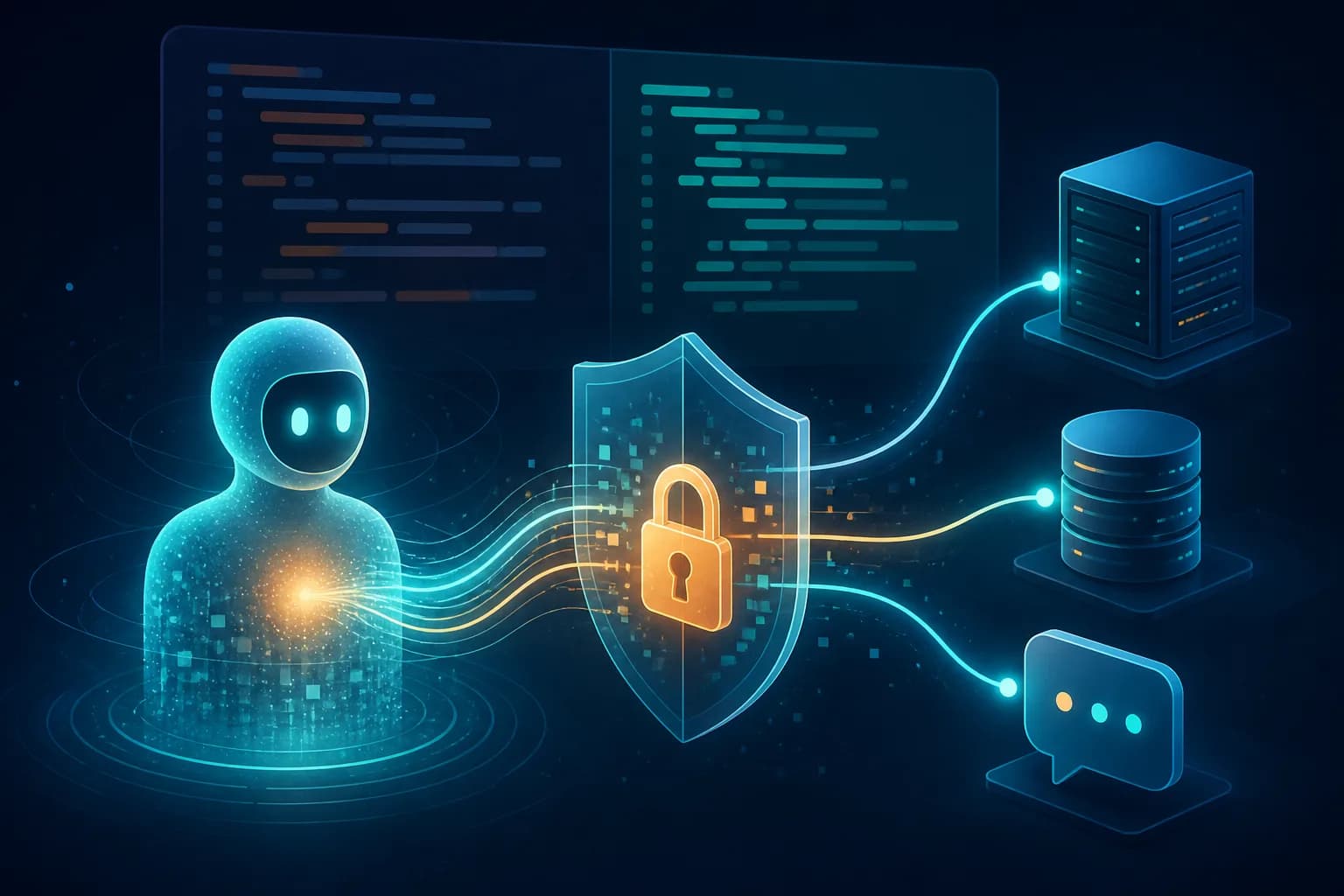
This week, Google documented exploit_agent, an AI system that compares a web application before and after a patch, figures out which flaw was fixed, and launches the attack. Almost at the same time, Microsoft's official agent-framework package on PyPI was compromised to steal credentials. For AI agent security, the message is clear: if you connect an agent to your ERP, your CRM, or WhatsApp, you have less time to patch, and the agent's own code can be the way in.
AI-powered attacks don't make the security practices you already know useless, but they punish whatever is left undone much faster. Below you'll find what happened, what changes in an AI integration with ERP and CRM systems, a table of controls with their owners, a step-by-step guide, and the questions you should ask your vendor.
If what you're looking for is how to protect the information AI processes, we cover that in our article "AI Security in Business: Protect Your Data and Processes." This piece focuses on something else: the agent as a technical user with access to your systems.
What happened: an agent that attacks and a poisoned library
exploit_agent: from patch to attack
On November 16, the Google Threat Intelligence Group (GTIG) reported that it had found, on an exposed server, a system that compares an application's code before and after a patch, deduces the fixed flaw, writes the attack, and launches it. Its operator was targeting French media, entertainment, and education sites. Google describes it as the first case it has observed of attacks that find and exploit flaws without a person directing them. The report also documents LLMJacking cases: stealing credentials to use, at the victim's expense, the AI services the victim pays for.
There are important nuances. Google has not seen fully autonomous attacks against still-unknown flaws in real targets, and it did not confirm that the exploit_agent attack succeeded. What matters for your company is the mechanism: every published patch also describes the flaw it fixes, and now a machine can read that description and act on it.
agent-framework: the risk came inside the library
On November 17, versions 1.26.1 and 1.26.2 of agent-framework appeared on PyPI, the public Python package repository. They were published 33 minutes apart and modified to steal Azure, AWS, GitHub, and OpenAI credentials. Microsoft acknowledged the compromise; the latest known clean version is 1.26.0. This is a library for building agents: exactly what gets installed when a company connects AI to its systems.
What changes when you connect agents to your ERP, CRM, or WhatsApp
An integrated agent isn't an isolated chat: it's a technical user that reads and writes to your systems using access keys. That changes three things:
- The patching window gets shorter. If a tool automates the jump from "patch published" to "attack ready," the ERP server, the customer portal, or the API the agent uses can't wait for quarterly maintenance.
- Libraries are part of your attack surface. An agent depends on dozens of packages. If one updates to a poisoned version, the keys to your ERP, CRM, WhatsApp Business, and AI account are all exposed on the same server.
- AI keys are worth money. With LLMJacking, the damage may not be a data leak but AI usage nobody authorized, and you're the one paying for it.
If you're going to design or review AI agents connected to your systems, these three points should be in scope from the pilot, not after launch.
AI agent security controls: reference table
| Control | Risk it prevents | Owner |
|---|---|---|
| Inventory of exposed systems | Forgotten, unpatched servers | IT with the vendor |
| Patching by severity | Attacks derived from the patch itself | IT |
| Pinned library versions | Poisoned packages | Development team |
| Least-privilege permissions per agent | A compromised agent reading or modifying everything | Process owner and IT |
| Credential rotation | Prolonged use of stolen keys | IT or security |
| AI spending monitoring | LLMJacking | Finance and IT |
| Agent action log | Being unable to reconstruct what happened | Vendor and audit |
| Questions for the vendor | Integrations without verifiable controls | Leadership |
The owner column is the one most often neglected: every control needs a named person. If the answer is "everyone," in practice no one is looking after it.
How to review your AI integration with ERP and CRM step by step
- Take inventory of everything the agent touches: ERP, CRM, WhatsApp Business number, servers, dashboards, and internet-facing APIs. A spreadsheet with system, version, whether it's exposed, and owner is enough. Result: you know what to patch first.
- Set patching timelines by severity. A reasonable policy calls for addressing critical flaws within days, high-severity ones within a few weeks, and the rest in the normal cycle; put it in writing and agree on it with your vendor. Result: patching no longer depends on "whenever there's time."
- Pin library versions in a lock file with hash verification, and check whether any project installed
agent-framework1.26.1 or 1.26.2. If so, roll back to a clean version and treat every credential on that server as compromised. Result: no update gets in without review. - Trim permissions and rotate credentials. Create one user per agent, with only the modules it needs and read-only whenever possible; store keys in a secrets manager, define how often they're renewed, and log every agent action. Result: if a key leaks, the damage is contained and traceable.
- Turn on spending alerts in your AI and cloud service accounts, with a threshold above your average daily usage. Result: you catch possible LLMJacking within days, not at month-end close.
Illustrative example
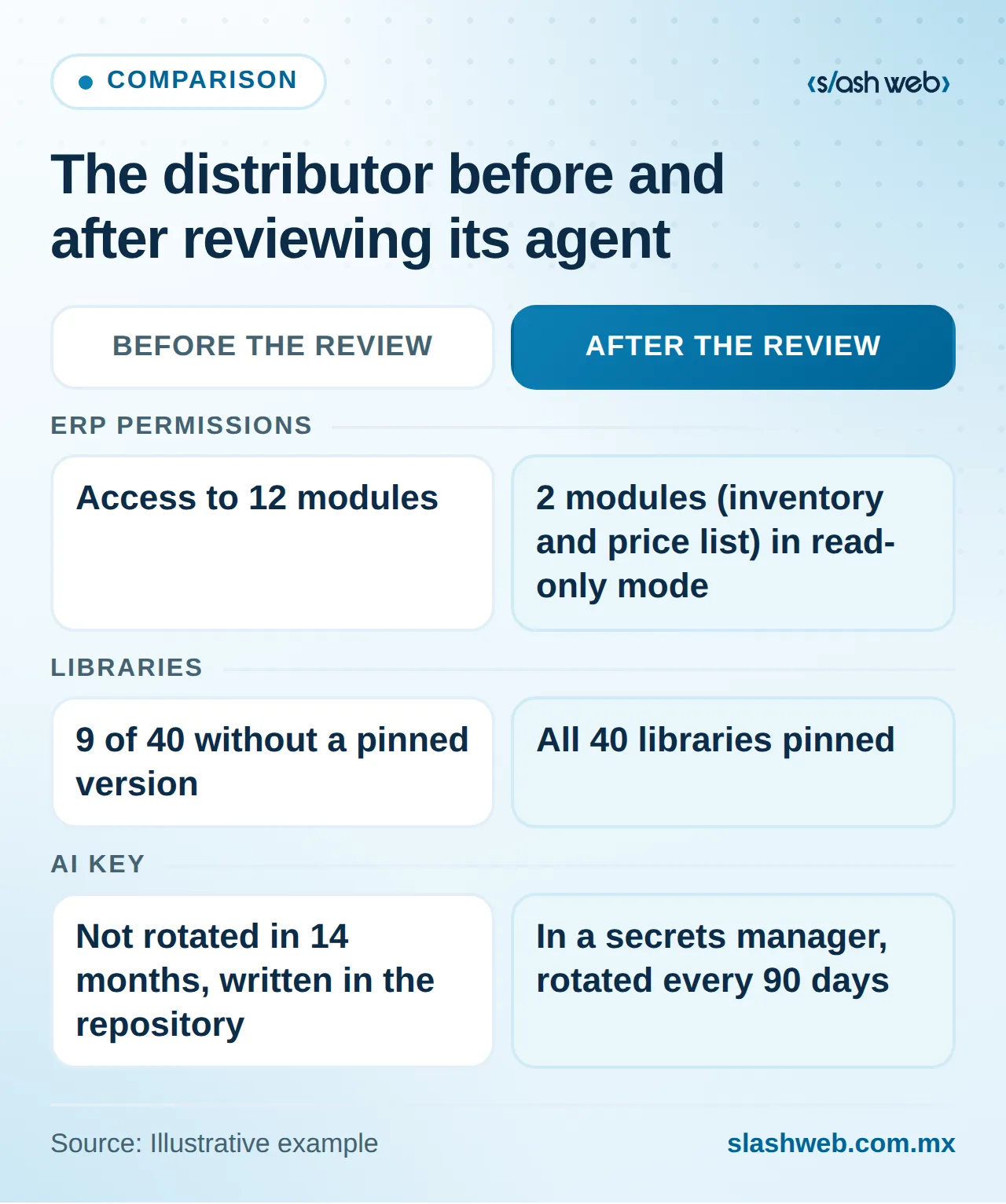
The figures are hypothetical and only show the method. A distributor connects a WhatsApp agent to its ERP to check inventory and to its CRM to log orders. During the review, it finds that:
- The agent's ERP user has access to 12 modules; it only needs 2 (inventory and price list), and in read-only mode.
- Of the project's 40 libraries, 9 don't have a pinned version.
- The AI API key hasn't been rotated in 14 months and is written in a file in the repository.
After applying the steps, the agent ends up with 2 read-only modules in the ERP and permission to create, but not delete, orders in the CRM; all 40 libraries are pinned; the key moves to a secrets manager with rotation every 90 days; and an alert fires if daily AI usage exceeds 1.5 times the average. If the ERP credential leaks tomorrow, whoever uses it can only check inventory, not payroll or accounts payable; if the AI key leaks, the abuse is detected before month-end close.
Common mistakes and questions for your vendor
Common mistakes and how to avoid them
- Giving the agent the admin account "so it works." Create its user with least-privilege permissions from the pilot: expanding later is easy; trimming in production isn't.
- Installing dependencies without pinned versions. A
pip installwithout a version pulls the latest release, even if it's compromised. Use a lock file and review every update. - Leaving keys in the code or the repository. Move them to a secrets manager and revoke any that were already exposed.
- Assuming the cloud or AI provider covers everything. They protect their platform; the permissions, keys, and libraries in your integration are on you and whoever built it.
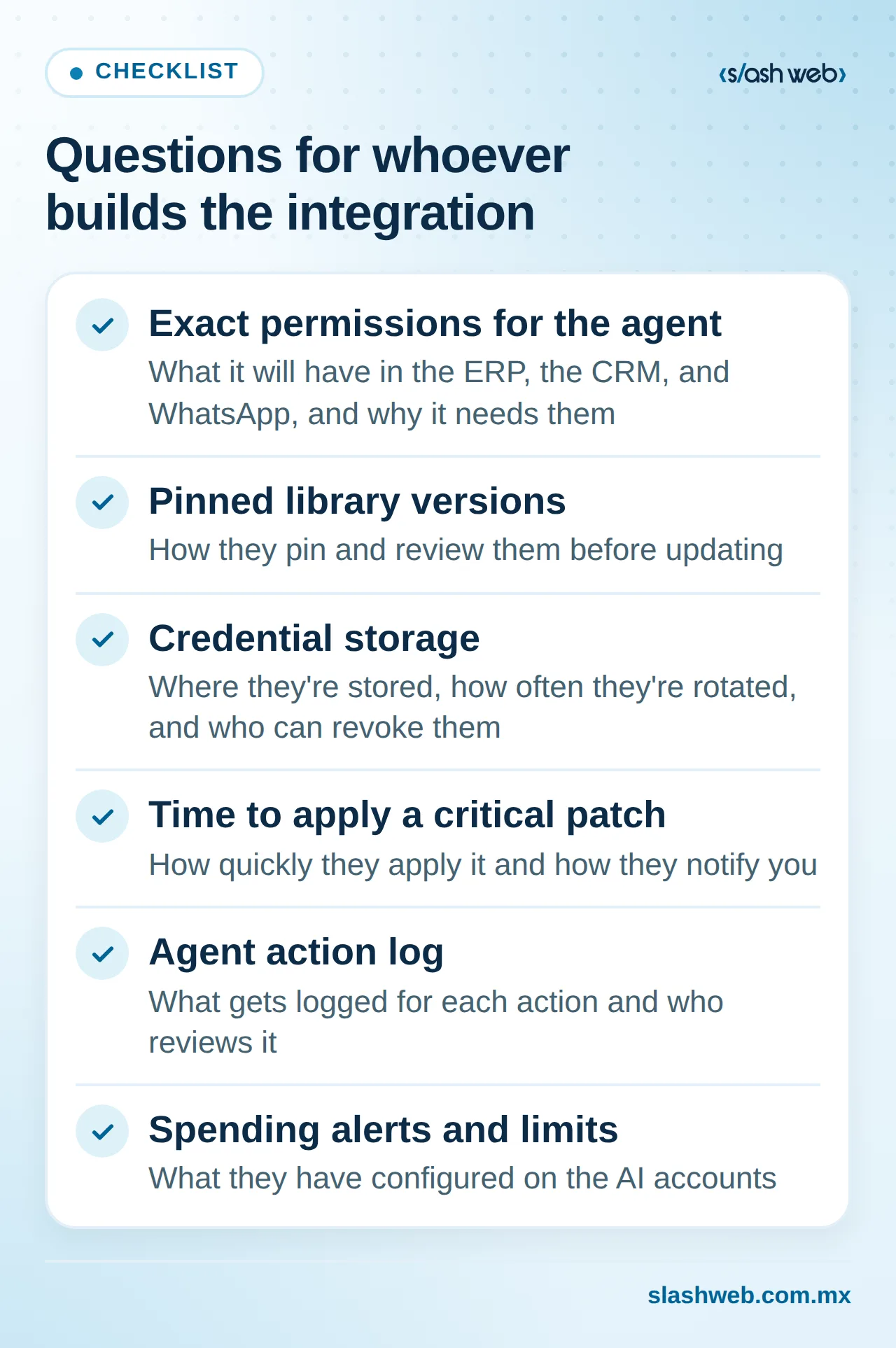
Questions for whoever builds the integration
- What exact permissions will the agent have in the ERP, the CRM, and WhatsApp, and why does it need them?
- How do you pin and review library versions before updating them?
- Where are credentials stored, how often are they rotated, and who can revoke them?
- How quickly do you apply a critical patch, and how do you notify me?
- What log is kept of each agent action, and who reviews it?
- What spending alerts and limits are configured on the AI accounts?
What to do this week
- Ask your team or vendor to search for
agent-frameworkacross all of the company's Python projects and confirm which version is installed. - Set up a spending alert or limit on every AI service account your company uses, whether OpenAI, Azure, AWS, or another.
- List the keys and technical users that connect your ERP, CRM, and WhatsApp, and flag the ones with admin permissions so you can trim them.
Conclusion
AI agent security doesn't require putting projects on hold; it requires treating agents as what they are: technical users with access to critical systems. The exploit_agent and agent-framework cases show two concrete fronts, patches that turn into attacks and libraries that get poisoned, and both are covered by well-known controls: inventory, patching by severity, pinned versions, least-privilege permissions, credential rotation, and spending monitoring.
At Slashweb, we design AI integrations with ERP, CRM, and WhatsApp that include these controls from the scoping stage. If you want to review an integration that's already running or plan a new one, tell us about your project and we'll review it with you.
Frequently asked questions
Should I stop using open-source libraries to build AI agents?
No. The agent-framework case shows that even an official package can be compromised, so the answer is about process: pinned versions, review before updating, and tracking security advisories for each dependency. Avoiding open source doesn't eliminate the risk; it just moves it somewhere else.
Can an AI agent have write permissions in my ERP?
Yes, as long as they're the minimum necessary and limited by type of operation. For sensitive actions, such as releasing payments, changing prices, or adding new suppliers, it's best for the agent to prepare the operation and have a person approve it. That way you get the benefits of automation without leaving critical decisions to a single key.
Do AI-powered attacks only affect large companies?
Google didn't describe the victims by size: the exploit_agent operator was targeting media, entertainment, and education sites. When an attack is automated, testing many targets costs less, so any exposed, unpatched system, whether it belongs to a small business or a large corporation, could be on the list.
How often should I review the security of my AI integrations?
Do a full review before going to production and every time you change models, libraries, or permissions. Between those changes, a periodic review, for example quarterly, helps catch unrotated keys and permissions that grew unchecked. Spending and vulnerability alerts should run continuously.
Slashweb
Want to apply this in your company?
Book a free call with a specialist and get a tailored proposal.